The fund
/10 · Transport · JV · 2026

Rayden — Magnetic Rail

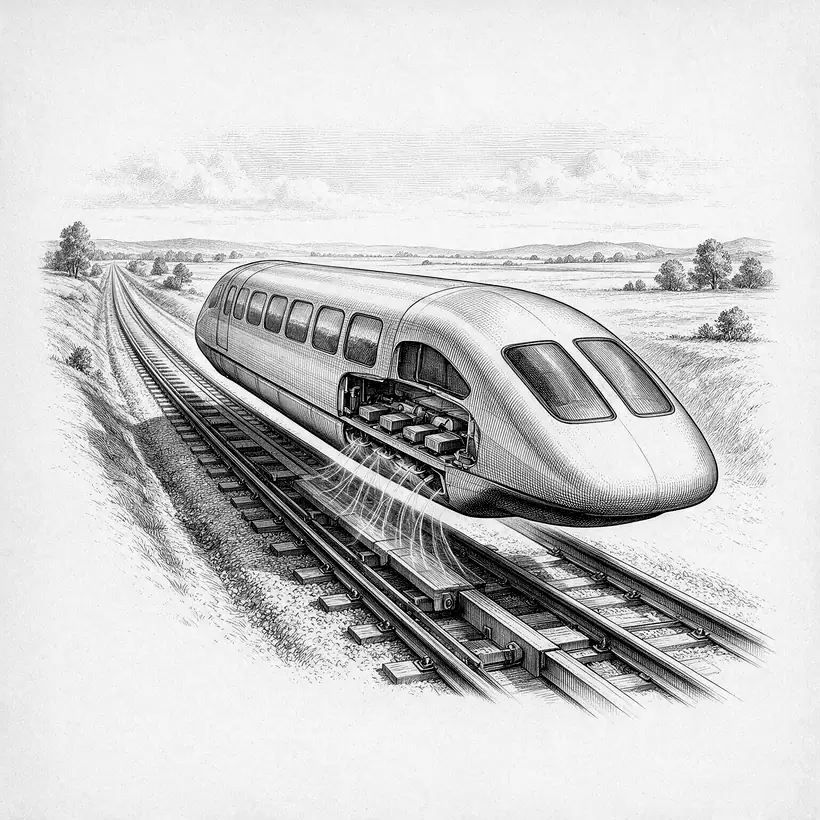
The next commitment. Passive levitation and linear propulsion fitted to conventional track — high-speed, high-capacity service on corridors that already exist, without acquiring a metre of new right of way.

Fig. — Rayden — Magnetic Rail Pignus
Rayden — Magnetic Rail
Passive levitation · linear motor · existing track
/01

The frontier

What is actually happening at the edge.

/01

Levitation without new land

Three levitation families are in service or in test worldwide: active electromagnetic suspension holding a millimetre-scale gap under continuous control; electrodynamic suspension using superconducting coils at a large gap, which still needs wheels at low speed; and passive permanent-magnet arrays that lift from currents induced in a conductive reaction element above a transition speed. Only the third has retrofit economics — Halbach arrays carried on the bogie, aluminium elements laid within the existing four-foot, wheels bearing the vehicle below transition and taking it back on any failure. The vehicle stays inside the loading gauge and can still run on unmodified track beyond the fitted section. The consequence is that the corridor, not the physics, sets the deployment map.
/02

The stator is the asset

Propulsion decides where the capital sits. A short-stator linear induction motor keeps the active hardware on the vehicle and the track cheap, but pays for it across the air gap and needs current collection at speed. A long-stator synchronous motor moves the winding into the trackbed: thrust is excellent and power transfer contactless, but cost migrates into segmented inverters, medium-voltage cabling and switching plant repeated along the line. Silicon-carbide devices have made those segment drives smaller and cooler, which is the main reason the retrofit case is arguable at all — and in either configuration tractive effort stops depending on wheel-rail adhesion, so gradient, ice and leaf fall cease to be operating constraints.

/03

Freight goes first

Freight is the honest first market. A self-propelled wagon under linear drive needs no locomotive and no marshalling yard: it departs when loaded, accelerates and brakes harder than a coupled block train, and therefore closes headways on corridors that are congested rather than slow. Ride comfort, pressure sealing and passenger evacuation — the expensive half of certification — do not apply. Port shuttles, intermodal terminal links and cross-border trunk hauls are where a fitted section pays before any passenger boards.

/04

Where the programme binds

The binding constraints are not levitation. Legacy train detection assumes a steel wheel; track circuits and axle counters do not see a vehicle that is airborne, and the stray fields of a linear motor sit close to the electromagnetic compatibility envelopes that ETCS balises and lineside detection were approved against — signalling integration, not lift, is the real approval path, and Europe has no interoperability specification for this class of vehicle. Alignment geometry still governs: curve radius and cant deficiency cap speed on an old corridor whether or not friction is present, so retrofit buys capacity and a step change in line speed, not dedicated high-speed numbers on a nineteenth-century survey. Upstream, high-coercivity NdFeB depends on dysprosium and terbium, and the coated-conductor tape used by the superconducting variants competes for the same production capacity that fusion is bidding for. Anyone serious in this field is, in practice, taking a position on magnets and power electronics as much as on rail.

/02

Our position

How the families stand in this field.

Rayden is the vertical being prepared, not one being reported. It will be taken as a joint venture and taken whole: the corridor, the fitted hardware and the operating right held together, because only all three at once survive a change of operator or of government. Railway capital is where these families began, and a corridor surveyed in the nineteenth century remains among the scarcest assets of the twenty-first. The commitment is being written on that basis.

Positioning favours the layer every deployment must buy from. Magnet assemblies, conductive reaction elements, segment inverters and lightweight bogie structures are common to every serious programme in the field, whichever line reaches financial close and whoever builds it. Exposure taken there is indifferent to national scheme selection and to political cycles. It is the slower and duller half of the industry, and the more defensible one.

Read as one map, the jurisdictions already under stewardship — Poland, Morocco, Malta, the United States, Egypt — are a set of freight corridors, ports and land bridges rather than five separate markets. Rayden will be assessed against that map first: fitted track that shortens a port hinterland or a border crossing before fitted track that shortens a journey. The three-year minimum term is short against infrastructure of this kind. Families that have held together for six generations are the appropriate counterparty for an asset whose working life outlasts the currency it is financed in.

/03

Other briefs

Participation in the fund is by introduction, from USD 100 million, for a minimum of three years.

Request an introduction