The fund
/04 · Infrastructure

AI Data Centres

Compute has become an industrial commodity with the physics of a smelter and the politics of a pipeline. The constraint is no longer silicon. It is power, water, land and consent.

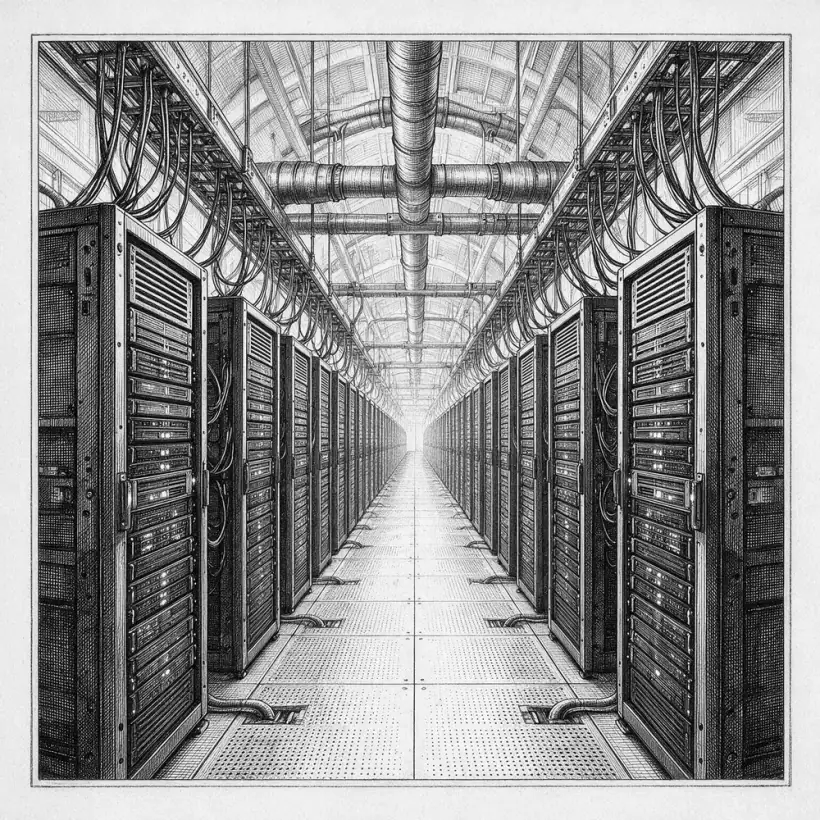
Fig. — AI Data Centres Pignus
AI Data Centres
Direct-to-chip liquid loop · 100MW+ campus
/01

The frontier

What is actually happening at the edge.

/01

The rack is a furnace

Enterprise halls were designed around five to ten kilowatts per rack; accelerator racks are now specified in the hundreds, with vendor roadmaps pointing beyond a megawatt. Air cannot carry that away. Direct-to-chip cold plates have become the default for new build, with single-phase immersion in service where density or water scarcity argues for it. The coolant distribution unit, not the chiller, now determines whether a hall runs, and rejection to dry coolers rather than evaporative towers is increasingly a permitting condition rather than an engineering preference.

/02

Power precedes permission

In the principal markets, grid interconnection queues are measured in years rather than months, and utilities have begun to ration new load rather than compete for it. The response is behind-the-meter generation: gas turbines and reciprocating engines contracted ahead of energisation, fuel cells at campus scale, long-term offtake against nuclear and hydro, and capital committed against small modular reactors for the next decade. A site with firm power and an executed interconnection agreement is a different asset class from a site holding planning consent alone.

/03

Inside the fence, direct current

Moving hundreds of megawatts through a campus at conventional voltages imposes copper, conversion losses and floor area the economics no longer tolerate. The industry is converging on high-voltage direct current distribution to the rack — 800-volt architectures, sidecar power shelves, solid-state transformers — with storage sized not for outage ride-through but for the second-scale load swings that synchronised training runs impose on the grid. That transient behaviour is now written into interconnection conditions, which makes electrical topology a commercial term rather than an engineering detail.

/04

Compute as a sovereign attribute

Data residency has widened into compute residency. States now legislate not merely where data rests but where models are trained, under whose operational control, on hardware subject to whose export regime. Accelerator allocation is itself a diplomatic instrument, governed by licence conditions, end-use verification and country tiers. The consequence is a durable premium on jurisdictionally clean capacity, domestically operated and auditable, and a discount on capacity that cannot demonstrate it.

/02

Our position

How the families stand in this field.

Capital that began in railways, energy and fuel reads this sector as familiar ground. The scarce input is not the machine but the interconnection agreement, the substation, the water permit, the fibre route and the fuel contract standing behind them. Such assets are assembled over years, and no balance sheet creates them at short notice. Positions are taken at that layer, upstream of the operators, and held for the life of a site.

The families sit along the chain rather than at one point on it: land and power rights secured ahead of demand, the thermal and electrical hardware that makes density possible, and the operating platforms that convert megawatts into contracted capacity. Exposure is structured to hold whichever laboratory or hyperscaler proves to be the eventual tenant, and whichever generation of accelerator occupies the hall.

A campus is a multi-decade asset serving equipment refreshed every few years; capital that must be returned inside a fund's life is the wrong capital for it. Positions sit across Poland, Morocco, Malta, the United States, Egypt and Oman, where grid position, climate and sovereign policy each argue for a different form of the same asset. When states, currencies and institutions are being re-ordered, holding through the turn requires a bond older than any of them.
/03

Other briefs

Participation in the fund is by introduction, from USD 100 million, for a minimum of three years.

Request an introduction