The fund
/03 · Energy · JV

Artificial Sun — Morocco

Magnetic confinement has passed from physics into plant engineering: rare-earth superconducting tape, plasmas held for a thousand seconds and more, and a siting question that ends with a wire running north into Europe.

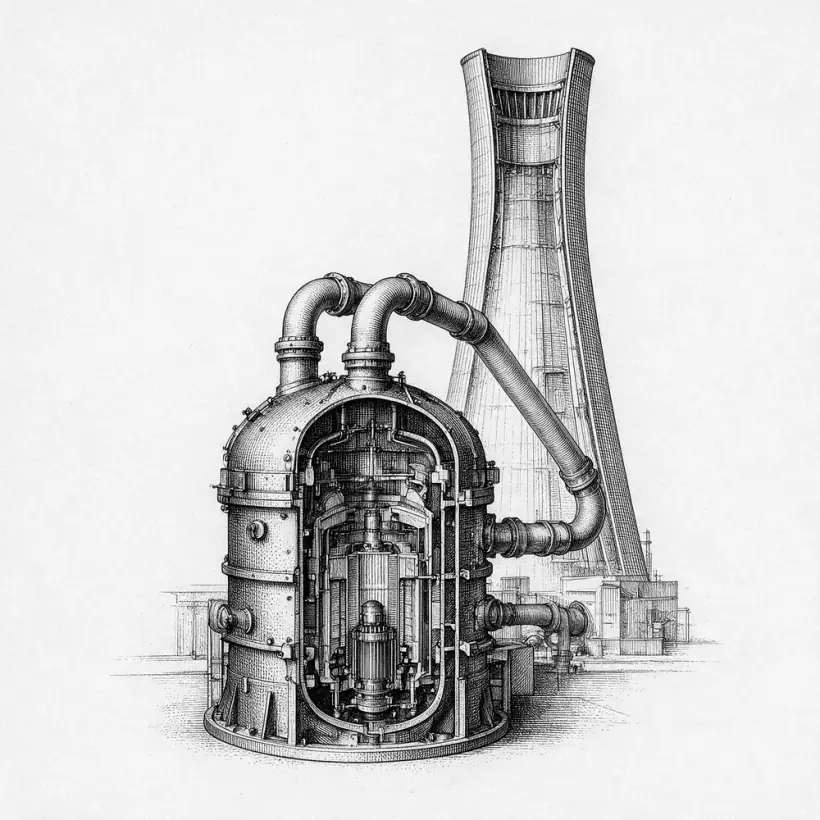
Fig. — Artificial Sun — Morocco Pignus
Artificial Sun — Morocco
Tokamak · REBCO magnets · export north
/01

The frontier

What is actually happening at the edge.

/01

The magnet is the machine

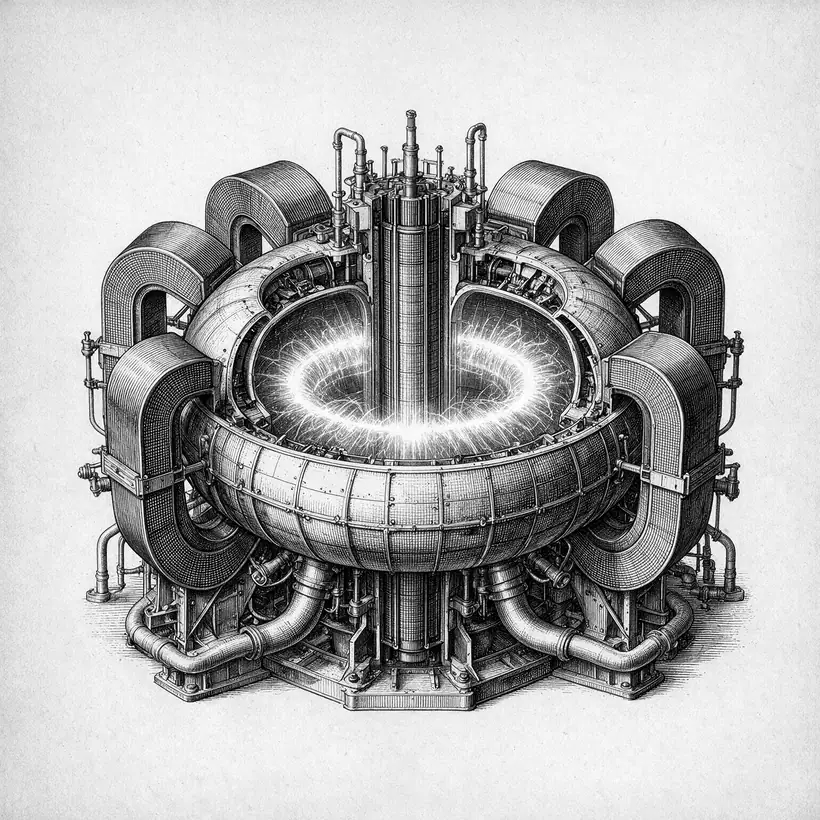
Fusion power scales with roughly the fourth power of the magnetic field, so the binding constraint has always been the conductor rather than the plasma. REBCO tape — rare-earth barium copper oxide grown as a coated ribbon and wound in no-insulation pancake coils — carries current above 20 tesla where niobium-tin gives out, which is why the machines now being built are a fraction of the volume of those designed twenty years ago. What remains is industrial rather than scientific: tape output measured in thousands of kilometres per reactor, joint resistance, and detecting a quench inside a winding that deliberately has no turn-to-turn insulation.

/02

Long pulse, then burn

In 2025 the long-pulse record moved into the thousands of seconds: EAST held a high-confinement plasma for 1,066 seconds and WEST ran 1,337 seconds in a lower-performance regime. That is steady state, not a shot — non-inductive current drive, real-time boundary control, an actively cooled first wall. Three classes of player set the pace: the large state programmes building burning-plasma devices, the ITER consortium on a rebaselined schedule that pushes deuterium–tritium operation into the late 2030s, and a cohort of privately capitalised HTS machines attempting net energy on a shorter cycle. The Chinese programme is notable for building a burning-plasma test device and a full fusion-technology campus in parallel, treating supply chain and physics as one problem.

/03

The wall and the fuel

Two engineering problems stand between a long plasma and a power station. The divertor must take the exhaust: tungsten monoblocks sit near ten megawatts per square metre in steady state, well below an unmitigated strike point, which forces detached operation, advanced magnetic geometries or liquid-metal surfaces. And nothing runs without a breeding blanket that makes more tritium than it burns — lithium-6 enrichment, a beryllium or lead multiplier, ceramic pebbles or flowing lead-lithium — because the world's civil tritium is a by-product of heavy-water fission reactors and decays at over five per cent a year. Neutron damage to all of it is still being characterised without a fusion-spectrum irradiation source at scale; the facility under construction in southern Spain is the field's quiet critical path.

/04

Desert siting, northern wire

A tokamak is a thermal plant with an awkward heat-rejection problem, and the desert answers part of it: land at scale, distance from population, and an industrial base already formed around the molten-salt solar complexes inland. It imposes dry or hybrid cooling and strict water discipline in return. Offtake is the harder half — the Strait already carries submarine circuits into Spain with further capacity long planned, and Iberia's own weak coupling to France remains the real bottleneck on power moving north. Regulation is the third variable and is diverging quickly: the United States has placed fusion under a byproduct-materials regime rather than reactor licensing, and the United Kingdom legislated it out of the nuclear-installations regime altogether, which leaves jurisdictions holding a competent nuclear regulator and no fission fleet unusually well placed.

/02

Our position

How the families stand in this field.

The durable positions in this field sit beneath the reactor rather than inside it. Conductor and tape capacity, cryogenic plant, refractory metals, lithium isotope separation, land, water rights and interconnection capacity are inputs every machine requires, whichever design reaches net energy first. Exposure of that kind pays on the progress of the sector rather than on the selection of its winner, and can be carried on a horizon long enough that a decade of slippage changes little.

Fusion is being partitioned by geopolitics before it is commercialised. The engineering base, the supply of superconducting tape and the fastest-building machines are concentrated in the East; the regulatory precedent, the grid and the industrial offtake sit in the West. A structure spread across several jurisdictions and answerable only to its own families can stand on both sides of that line at a moment when institutional capital is increasingly required to choose one.

Six generations of this capital came out of railways, fuel and power — assets bolted to a place, licensed by whoever governs it, and useful under every currency that has come and gone since. A reactor on the edge of the Sahara with a wire running north is the same asset in a newer form: immovable, sovereign in character, and valuable in precisely the conditions that destroy paper. Such things are underwritten for the grandchildren of the present partners, and priced on that horizon.
/03

Other briefs

Participation in the fund is by introduction, from USD 100 million, for a minimum of three years.

Request an introduction