The fund
/07 · Deep tech

Defence & Military Technology

Europe is rebuilding an industrial base it spent thirty years dismantling. The binding constraint is not design but capacity — energetics, forgings, propellant, skilled hands — and capacity is bought in decades, not budget cycles.

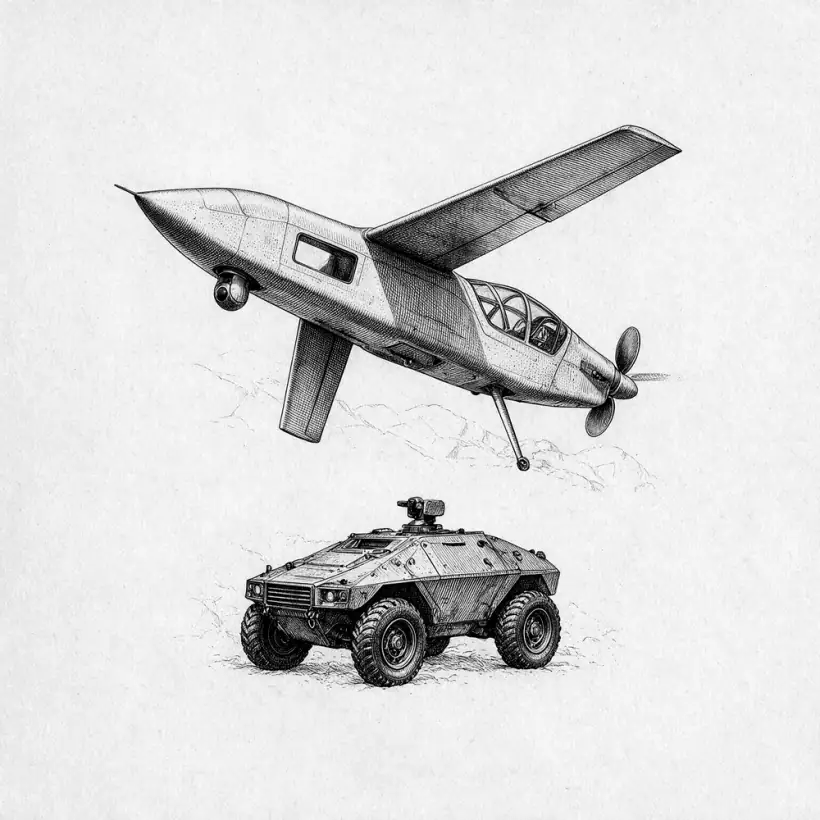
Fig. — Defence & Military Technology Pignus
Defence & Military Technology
Protected mobility · attritable mass · contested spectrum
/01

The frontier

What is actually happening at the edge.

/01

The cost curve inverted

Small one-way effectors have cut the cost of a precise kill by orders of magnitude, and the difficult work has moved to the last mile: machine-vision terminal homing that survives a jammed control link, fibre-optic tethers that cannot be jammed at all, and inertial-visual navigation for airspace where satellite positioning is denied. Loitering munitions and deep-strike one-way aircraft have made reach a question of airframe economics rather than missile budgets. The exchange ratio that follows punishes whatever is expensive, crewed and stationary.

/02

Defeating cheap mass

Counter-UAS is a layered problem: passive radio-frequency detection, acoustics and small-aperture radar to find the object, then a ladder of effectors priced against the threat — jamming and spoofing, high-power microwave, directed energy, proximity-fuzed thirty and forty millimetre airburst, and interceptor drones built to the same attritable logic as the target. Cost per engagement is the unresolved constraint; it must sit below cost per threat or the defence loses on arithmetic. The same pressure on land has revived hard-kill active protection, top-attack countermeasures, signature management and dispersal, and with them the case for protected mobility that is survivable rather than merely heavy.

/03

Autonomy and the kill chain

Automatic target recognition now runs on size, weight and power-constrained edge hardware, giving an airframe the seconds of terminal autonomy it needs when the link drops, and giving several cheap airframes the means to co-operate. Above the effector sits command software that fuses sensor feeds into a targeting picture and compresses the interval between detection and decision, carried on mesh radio and proliferated low-earth-orbit constellations, and built to modular open architectures so the software can be replaced faster than the platform it rides on. The scarce inputs are labelled operational data, instrumented test ranges, and doctrine that permits a commander to act on a machine's recommendation.

/04

Capacity is the constraint

The bottleneck sits upstream of every platform: nitrocellulose, TNT and propellant lines; solid rocket motor capacity; long-lead forgings, presses and heavy machine tools ordered years ahead; qualification timelines no order book can compress. Beneath that runs a dual-use dependency — rare-earth magnets, MEMS inertial units, cooled infrared detectors, small turbojets — whose supply chains pass through a very small number of countries, which is why sovereign and export-clean sourcing has become a procurement criterion rather than a preference. Multi-year framework orders and alliance spending commitments extending into the next decade have produced, for the first time in a generation, a demand signal long enough to finance new plant.

/02

Our position

How the families stand in this field.

The four roots of these holdings — railways, energy, fuel and information systems — are the assets a continent depends on when it has to move an army. Military mobility is a question of gauge, axle load, bridge classification and corridor control before it is a question of doctrine; sustainment is a question of fuel, storage and pipeline; command is a question of software. Exposure to defence therefore begins one layer beneath the platforms, in the infrastructure that decides whether platforms arrive at all.

Positions are taken across the stack rather than on a single programme: energetics and precision manufacture at the base, sensing and effectors in the middle, autonomy and command software above. The bias is towards capacity that takes years to qualify and cannot be improvised — the part of the industry where patient capital is the condition of entry rather than merely an advantage. Holdings sit on both shores of the Mediterranean and both sides of the Atlantic, a spread the sector imposes rather than the families prefer: export control, offset obligation and national security screening decide what may be owned, and by whom.

Rearmament is a political cycle and will in time turn. The families underwrite on that assumption: assets are chosen for what they remain worth to a sovereign customer through a downturn — plant, land, certified processes, cleared people, installed base — not for the height of an order book. Against the horizon applied to this vertical, a three-year minimum term is a short commitment.
/03

Other briefs

Participation in the fund is by introduction, from USD 100 million, for a minimum of three years.

Request an introduction