The fund
/11 · Transport · after Rayden

Cargo Airships

Most of the world's remaining minerals, its best wind and its hardest humanitarian ground lie beyond the last road, port and crane. Buoyant lift is the only transport class that treats that as an address rather than an obstacle.

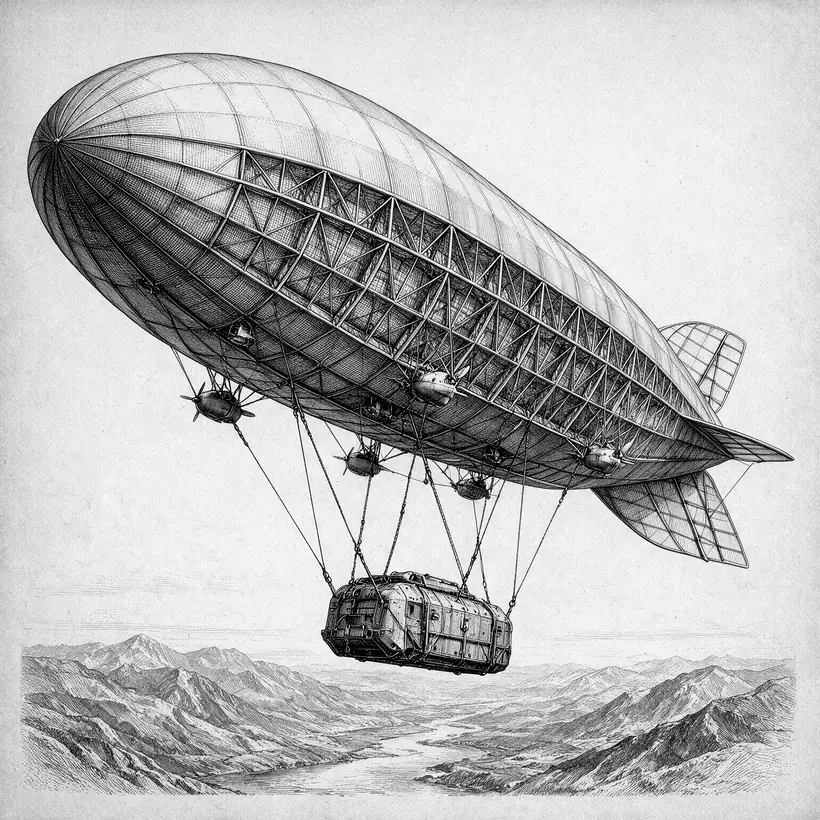
Fig. — Cargo Airships Pignus
Cargo Airships
Buoyant heavy lift · no road, no port, no crane
/01

The frontier

What is actually happening at the edge.

/01

Two architectures, both flying

The rigid airship has been rebuilt out of materials that did not exist when it was abandoned: carbon-fibre truss frames with metallic nodes, envelopes laminated from high-modulus aramid and liquid-crystal polymer fibre over vapour-barrier films, welded rather than sewn, instrumented through the hull. Beside it sits the hybrid, which takes part of its lift aerodynamically from a shaped body and lands on an air cushion — heavier than air when loaded, therefore far better behaved on the ground, at the price of needing a strip to run on. Full-scale prototypes of both classes now fly. The category has moved from renderings to flight test, which is where its real problems begin.
/02

Ballast is the discipline

When sixty tonnes leave the hold the vehicle does not become lighter — it becomes uncontrollably light. Variable-buoyancy management is what the entire category turns on: water ballast exchange at the point of delivery, compression of lift gas into hard tanks to trade volume for density, condensing engine exhaust to recover water in flight, and vectored thrust holding the ship down while the load comes off. Fuel burn does the same thing slowly; solar superheat and night cooling move trim by the hour without anyone touching a control. Writing flight-control laws for a vehicle whose mass and whose lift both drift independently is a harder engineering problem than the airframe.

/03

The gas question

Helium's entire case is that it will not burn. Against that: it is scarce, produced from a handful of gas fields under a small number of flags, priced accordingly, and it escapes through any membrane humans can manufacture — permeability is a specified figure in litres per square metre per day, and ground-side reclamation and purification is a permanent line of operating cost, not a capital item. A cubic metre lifts roughly a kilogram, so lifting hundreds of tonnes means enclosing volume in the hundreds of thousands of cubic metres. The technical argument for returning to compartmentalised hydrogen with modern leak detection and inert barriers is respectable and politically almost closed; the near-term answer is better barrier films and closed-loop gas handling.

/04

Mooring-free, and the certificate

An airship was historically landed by scores of men on ropes into a mast. The requirement now is to arrive over an unprepared site — a pit head, a river bank, a flattened town — hold station in a crosswind, winch down a process module or a turbine blade too long for any road, take on ballast and leave, with no mast, no hangar and no ground crew. That is an autonomy and station-keeping problem, and it is what separates a demonstrator from a freight business. The other gate is regulatory: European authorities have issued a special condition for large gas airships, while no modern transport-category rule set exists elsewhere, so the schedule risk in this field is certification and airspace integration rather than aerodynamics.

/02

Our position

How the families stand in this field.

This is a pipeline line, taken up after Rayden, and it will be approached the way the earlier lines were: across the stack rather than at the vehicle. Barrier laminates and gas reclamation, buoyancy control and station-keeping software, the ground segment — mooring points, load frames, corridors, crews — and above all the offtake, meaning the mines, grids, ministries and relief agencies that would actually consign the cargo. The flying machine is the visible part of this field and the smallest part of its value.

The families' roots are railways, energy and fuel. Buoyant lift is the same business under a different physics: moving mass to the place where it earns, on ground the railway never reached and the port cannot serve. It suits a holder who can wait — this is a certification-and-fleet undertaking measured in decades, not a product cycle — and it suits capital that already understands the terrain, because the jurisdictions in which these families sit are precisely those where the last hundred kilometres are the whole of the problem.

Heavy lift without runway, port or crane is a sovereign capability before it is a freight service. States will license it, want it, and in places insist on holding the corridor themselves. A group positioned across a field of that shape enters early and quietly, where the licence, the terrain and the offtake meet, and long before the category is priced.

/03

Other briefs

Participation in the fund is by introduction, from USD 100 million, for a minimum of three years.

Request an introduction